Hive Havoc: Nature's Drummers
For me it started badly and went down hill. Autumn brought wasps, the Messerschmitt of the insect world, to terrorise one of my apiaries which were then nobly assisted by hornets, European and one Asian.
On the strength of the yellow legged hornet Defra came out to inspect. My traps were full of thousands of predatory insects and the one yellow legged hornet. Mr Defra got a bit tutty, retrieved the continental interloper, and then let all the other insects out, thousands of wasps and a good few hundred European hornets. “They are native insects so we don’t want to kill them”. I pointed out that the hornets didn’t get that fat feasting on midges.
Meanwhile, the previous inhabitants of my traps flew off once again to resume their predation of my hives. I shut down entrances and got on with a busy harvest, the land owner assured me that it was not a bad year for wasps as he had hardly seen any. Of course he hadn’t seen any; they were busy feasting on my hives.
Woodpeckers are another winter hazard renowned for their ability to chop holes in trees looking for insects.
Around here the telegraph poles are pockmarked with the signs of their attacks, odd really because there are no insects in them owing to the tar the poles have been treated with.
Woodpeckers also have this problem: they are as good at whistling as the late Bernard Manning was at playing the piano.
To call a mate in the spring they like to play a paradiddle on a sounding board and this year it was my luck to have two of my hives chosen for a woodpecker to call for a mate across the valley.
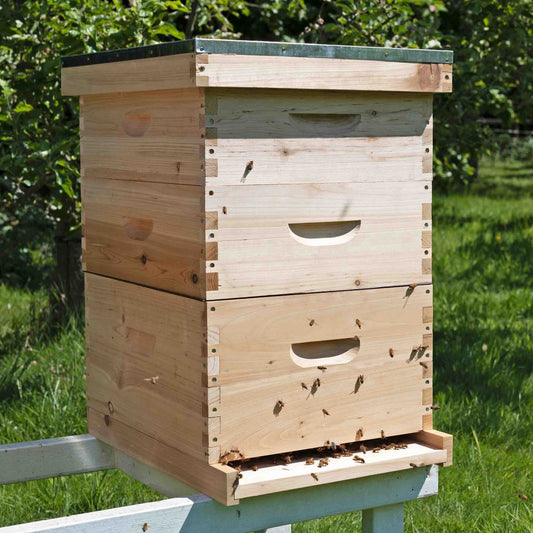
No great damage to the hive nor the bees except for a little extra ventilation. I have a well stocked workshop and a few 25mm wood plugs soon filled the holes. I guess that’s why wrapping a hive in a plastic bag works as a deterrent, a snare drum in an old bin liner wouldn’t sound good either.
On to the new season then, and time to get the bait hives out. Lots of research has been done on this, particularly by Thomas Seeley. The right size for a bait box is the size of a Langstroth hive, but Luddites could use a national hive!!
I use up my manky old hives that are well past their best. Hives are best stocked with just a couple of frames in the middle (I tack mine in place to hold them securely). If you can get your box about 6 feet off the ground that’s good. Lastly - and oddly - two bait boxes side by side work much better than boxes placed individually.
When scout bees find a potential new home, they will march around inside it to get a feel of the full dimensions. (Remember, these are female bees; if it was down to the drones, it would be just a case of is it close enough to a drone congregation area - never mind the curtains). Right, I am off to put some hives out then; three or four placed out of sight should be good.