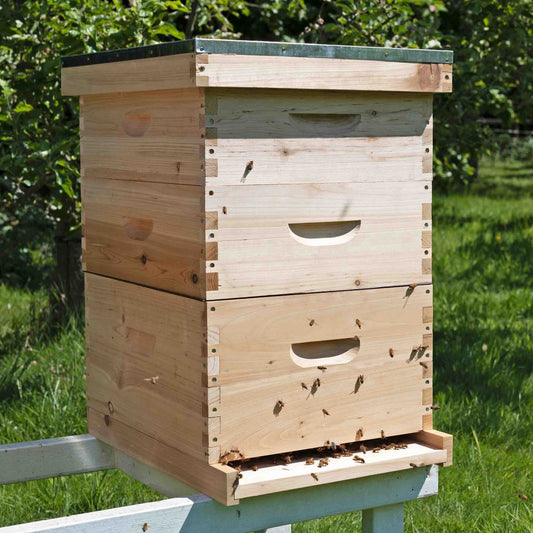
How to do a Lazy Snelgrove to prevent your bees from swarming
Method
So, your hive is bursting with bees, and there are queen cells; it is time to do something. I always use a ‘hop-up’ when I am going through hives so that I don’t have to put anything on the ground. It is not strictly necessary, and a spare hive stand will just about suffice.
It is always best if you can locate the queen and contain her whilst doing this, although it is not critical. Unfortunately, when the hive is at this stage, the queen will have been slimmed down and can be wandering all over the brood box rather than being on a frame doing her usual job of laying copious quantities of eggs. I use a ‘crown of thorns’ to pop over the queen if I find her, just while I am sorting things out.
1. Move the supers to one side for the moment. Put a multi-function eke or entrance board on your hop-up and move the brood box onto it, leaving the floorboard on the hive stand.
2. Place your two supers on the hive stand but without the centre two frames. If one of the supers is new or undrawn, put that one on the bottom.
3. Go through your brood box and find two nice frames with brood and eggs. Ideally, at least one of them should have a nice, newly formed queen cell—not yet drawn out, but with a tiny larva floating in its pool of food—or at the very least, eggs and young brood. It’s imperative that the queen is not on these frames, so if you haven’t seen her, brush (do not shake) all the adhering bees off. Put these two frames down through the supers where you previously removed the frames.
I like to go through the brood box and remove any other queen cells, although it is not catastrophic if you miss one. Then, place the eke/entrance board with the brood box on top of the supers with the entrance FACING BACKWARDS. You are now missing two frames in the brood box, so shove all the frames to one side and make the space up on the other side with two of your super frames. They obviously won’t go all the way down to fill the space, but it doesn’t matter and the bees will take no notice. You will have two other frames left over which, if there is no honey in them, you can just store under the hive until your next visit.
Pop the crown board and roof on, and you are done for a week.
Let’s look at what is happening: the brood box on top will lose all its flying bees, as they will return to the entrance they are habituated to, which now contains the two supers. The queen in the top box will have young bees but no flying bees; they will knock down any remaining queen cells, and the queen will recommence laying. They don’t need a super because there will be little food coming in during the next week. Crucially, they are not going to swarm.
The two (or more) supers on the bottom will have all the flying bees and some young bees that were already in the supers. They will have no queen for at least the next ten days. They can happily go about their daily task of bringing in the goodies, but they cannot swarm.
Next week—or when you can, but before ten days have passed—it is time to reverse everything. Take off the entrance board with the brood box and put it to one side. Now, take out the two brood frames from the centre of the two supers and pop them in a nuc. If you wish to quickly build up new stock, you can also add another frame of emerging brood from the brood box.
Rebuild the hive as it was originally: the brood box with extra frames added as required, the queen excluder, and then the supers. There is just one problem: some of the bees that were in the top box are now looking for an entrance around the back. One solution is to put the entrance board upside down on top so that any of those returning bees enter the hive from the top.
An issue with this is that the entrance created may be covered by the roof sides, in which case a spare super can be put on top to allow for the overhang of the roof. If you use an eke (sometimes called a multipurpose crown board), there is no problem creating a top entrance that leads down to the hive. After a week or so, this top entrance can be blocked off as the bees will have become used to coming out of the front door. I cheat now and have a circular entrance on the back of my brood boxes (a back door, if you like) which I can open and close as required.
The bees should have gone off the idea of swarming for a while, as a lot of brood will have hatched out and left room for the queen to lay; plus, she has at least two more frames that need to be drawn and laid in. The worst-case scenario is that next week, when you return, they have started queen cells again. This is not a problem; you can go through the process again, but this time at week two you can put in a new queen (the bees in the bottom box are expecting one) or you can just reconfigure the hive, removing the queen and letting them complete the raising of just one queen cell.
This system works for me and can result in big hives producing lots of honey, but I don’t claim it is foolproof. Towards the end of the season, when the need to keep the hive boiling strong has passed, it is a good idea to let them requeen or replace the old queen with one you have raised in a nuc. You don’t need to lose the nuc; you can just swap queens—new queen in the hive, old queen in the nuc. It sounds complicated, but once you get the hang of moving things around, it is very quick and easy.