On the brink of spring
What’s to like about January? Not a lot, really, except for the anticipation of the year to come.
Now that we've reached February, nature is teetering on the brink of a new season. My poor, displaced almond tree, which should be somewhere sensible like Portugal, is just coming into flower. If we do get a warm day this month – a long shot, I know – the bees will be out to eliminate waste and then find the tree with its sparse pollen and nectar.
I have finished all my equipment repairs. I use some great screws with big pan heads that are excellent for pulling together the warping sides of hives. They do need to be pre-drilled, but they will hold a hive together until it falls apart around them. I also have a supply of angle brackets; they are not the most beautiful things, but they do a decent job of repairing the abused corners of boxes trashed by excessive use of a hive tool.
I also bought a hive from Temu this winter, which was a mistake, really. I scrolled through their sales, putting various items into my basket in anticipation of some mysterious 'money off' voucher which never appeared. A couple of days later, I did some more shopping and purchased the previously mentioned angle brackets. When I pressed the 'buy now' button, I also bought a complete Langstroth hive which was still lurking in my shopping basket.
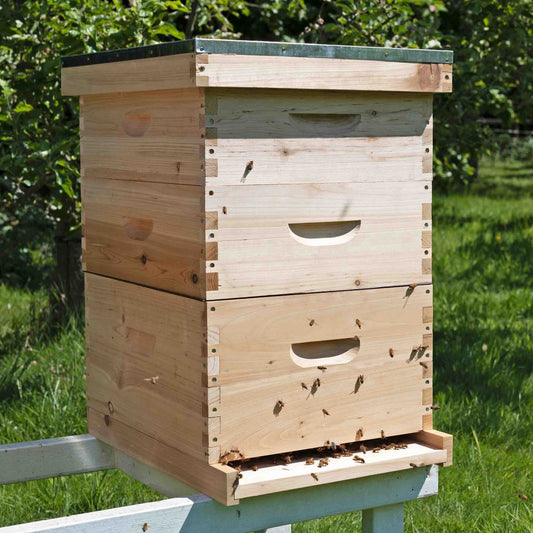
The hive was a stunning deal: two brood boxes, a floor, a roof, an excluder and a crown board for £50. For the price, I was pleased, though the floor was absolute rubbish and needed taking apart and rebuilding. This was not a problem, as there had been no glue, the only fixings being tiny pin nails. The roof was also just pinned together, so it got an extra screw at each corner. The boxes, with their neat dovetail joints, were all flat-packed, so they could be nicely screwed and glued together. All in all, it was a good result. I did have to 'accidentally' order some more frames from the Thornes sale, which were very economical at £42 for 50 of them. I make the wax foundation myself. So, altogether, I had a complete hive for less than £100.
I like to check my hives once a week or thereabouts. I know some beekeepers shut their hives down for the winter and then don’t revisit them until the spring. Where is the fun in that? Things can happen: hives can blow over, rabbits will happily undermine a hive, and woodpeckers can chomp through the side of a cedar hive in a day to feast on your bees. (I paint my hives, which disguises them nicely. Leave an unpainted, manky-looking hive out in a field and Mr Woodpecker will recognise it for what it is: a tree full of insects.)
Sadly, there are unscrupulous beekeepers who will 're-home' your hive, and yobs who will amuse themselves by kicking a hive over. You wouldn’t park your bike at the local railway station one autumn and expect it still to be there the next spring; even the next day is unlikely. So, check your hives. On a nice day, I chuck the dog in the car and take the 'horrible hound' around my apiaries. In the winter, he will get out of the car and have a run around, although he won’t lift his leg against a hive; he knows that’s a mistake. In the summer, much as he likes going out, if the bee equipment is in the car, he votes for a lazy day at home.
Nothing more to do now than go through the bee shed and check for wax moth and rodents. A mouse can trash frames and foundation, and a rat can do serious damage, rampaging through boxes and gnawing through everything. The wax moth, whilst it may be the smallest of scavengers, can, along with its siblings, cause major devastation. I know of one beekeeper who is local to me who lost the wax foundation out of ninety supers; that was a big loss and a lot of work.