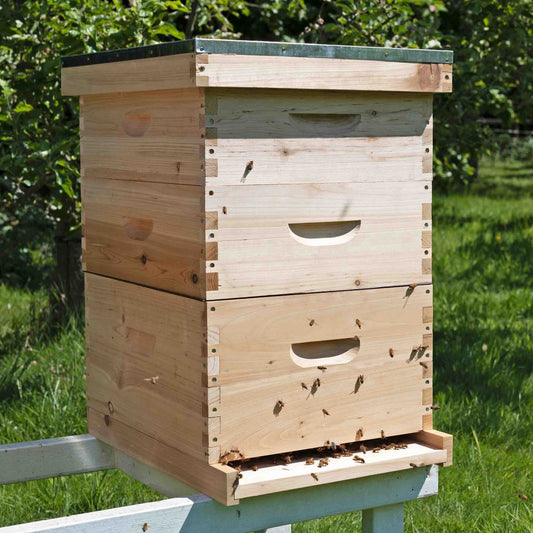
Ready for action
At last, winter is fading away, and days of reading and planning about bees will soon be replaced by action. Beekeeping in the past was not all about honey. We all know about monasteries keeping bees to supply wax for candles, with honey being a mere bonus by-product. Imagine poor old monks slathering honey on their morning toast and imbibing a flagon of mead in the evening so that they were fit and able to pray for the sinners.
Beeswax had more uses than that. Good old Cleopatra mixed smashed-up insects (cochineal) and beeswax to make lipstick, which some say helped to cause the downfall of Mark Antony. Bronze casting by the lost wax process was being practised as long ago as 6,500 years. Guys like Benvenuto Cellini in the sixteenth century were using beeswax to cast gold and silver ornaments and bronze statues.
There was even a more prosaic use of wax: our neolithic ancestors used pottery to store food, but the firing process was a bit dodgy as they were still several thousand years away from an electric kiln. Pots almost invariably had cracks and fissures in them, and beeswax was used to seal the voids, like an early Decaflex. Even in Roman times, potters still had issues with flaws in their pots, which they would sneakily fill with a mixture of ground clay and beeswax.
Nonstick frying pans not being available at the time and being as likely as a man walking on the moon, any liquid food had to be cooked in a pottery vessel. This is where a wax repair came to be a real problem. Flawless pottery vessels for cooking came to be sold as “without Wax.” The Latin for “without wax” being: ‘sine cera’. This is why, before manners disappeared with the arrival of the internet and emails, we signed our letters ‘Yours sincerely’ to imply that we meant something honestly without deception.
Thank God it’s March at last; you can almost smell the honey in the air. There is still a chance of a cold snap: indeed, snow is more likely this month than at Christmas. Of course, we have all finished those beekeeping jobs: honey supers ready, spare brood boxes built, new wax in frames ready to replace those manky black frames in the hives. Plans made for the season, everything in place for swarming time, which I know to my cost can happen as soon as the end of this month.
With that in mind, I will now have a spare super over the crown board on all my hives, a sterilised hive complete with new frames and foundation, a bait hive, a nuc, and an Apidea mating nuc all set up in each of my apiaries. Now it’s just waiting for the day when you can do that first inspection. Tee-shirt weather is supposed to be the criteria (might never happen in some places). 14 degrees and no wind seems to be the minimum. As soon as possible, I will replace floorboards on my hives, even if it is not warm enough to do an inspection.
My last maintenance job has been my honey room (converted garage), which was looking a bit sad. Somehow the walls seemed to be covered in lots of little brown dots, which had to be scrubbed off, and then the walls repainted. I then made a major mistake in telling my wife that I had repainted the room (stupidly I thought praise was in order). The only comment was: “Good, because the sitting room badly needs repainting as well.”